


字典树
字典树 (Trie) 这一概念有时候会跟基数树 (Radix Tree)、前缀树(Prefix Tree) 等混用。其中前缀树、字典树是从字符串存储角度的称呼,基数树更多是从数值 (多为二进制) 角度的称呼,可以看作广义的字典树。以下以字典树来统称字典树和基数树。
关于字典树的介绍,前面的文章 有一个直观的介绍,也不多赘述。
功能对比
| 数据结构 | 增加 | 删除 | 精确查找 | 极值查找 | 顺序遍历 | 前缀遍历 | 数据约束 |
|---|---|---|---|---|---|---|---|
| 哈希表 | √ | √ | √ | 哈希函数; 等于比较 | |||
| 堆 | √ | √ | √ | 小于比较 | |||
| 平衡树 | √ | √ | √ | √ | √ | √ | 小于比较 |
| 字典树 | √ | √ | √ | √ | √ | √ | 二进制比较(字符比较) |
基础版本字典树的特点:
- 查询时间只和 key 长度有关,和树中的节点数量无关
- 设每个字符长度是 s bits,一个 key 长度是 k bits,最多只需要比较 k / s 个 node
不足:
- 基本只适用于基本数据(整数,字符串、二进制串)
- 很难像哈希表或者平衡树那样,通过自定义哈希函数或者比较函数来存储自定义类型
字典树的优化方向:
- 减少内存 overhead(减少节点大小、分支数量、节点层数)
- 缓存友好
常规优化
还是主要参见前面介绍 HAT 的文章。主要有:
- 字母表缩减。可以看作基数树换用更小的基数。代价是树的深度变大,速度慢。
- 使用关联容器。代价是每次索引运算量增大。
- 压缩字典树。把只有一个分叉的节点,连同其唯一的孩子,结合成一个节点。可以通过插入过程中分裂节点来实现:

PATRICIA trie 及其变体
PATRICIA trie,是一种特殊的字典树,每个中间节点记录 key 之间公共前缀的位置。从此位置之后,key 之间产生不同,根据接下来的不同字符,转到不同的子分支。
Critial Bit trie
从基数树的角度看,PATRICIA trie 最简单的一个实现是二进制的,即 Critial Bit trie(cb trie)。critical bit 的意思是两个串共同前缀分叉之处的比特。参见: https://cr.yp.to/critbit.html (这个作者对 cb trie 的吹捧,说实话有点过了)。
两种节点类型:
- 中间节点:存储 critical-bit 的位置,以及左右两个子树
- 叶子结点:存储整个串
构造流程(采用网上某个介绍进行了修改):
        empty   -- initial state

---------------------------------------------------

       01234    -- number bit positions
insert 01011    -- the key


result root ----> 01011

---------------------------------------------------

insert 01010
    search ends at 01011~=01010;
    1st difference is at position 4, so...

result root ----> [4]    -- i.e. test position #4
                 .   .
               0.     .1
              .        .
           01010     01001

---------------------------------------------------

insert 10
    has no position #4;
    can skip key positions but must test in order, so...

result root ----> [0]    -- i.e. test position #0
                 .   .
               0.     .1
              .        .
           [4]          10
          .   .
        0.     .1
       .         .
     01010      01011

---------------------------------------------------

insert 000110;
    search ends at 01011~=000110;
    can skip key positions but must test in order, so...

result root ----> [0]
                 .   .
               0.     .1
              .        .
           [1]          10
          .   .
        0.     .1
       .         .
    000110       [4]
                .   .
              0.     .1
             .         .
            01010     01011

---------------------------------------------------

insert 01;
    01 is also a prefix of 01010 and 01011;
    must have ability to terminate at an intermediate node, as with Tries.
result root ----> [0]
                 .   .
               0.     .1
              .        .
           [1]          10
          .   .
        0.     .1
       .         .
    000110       [2] ---> 01
                  .
                 0.
                  .
                 [4]
                .   .
              0.      .1
             .          .
          01010        01011
quelques-bits popcount trie
为了减少 cb trie 的深度,采用 4 比特一组进行比较。即,基数树以 2 的 4 次方等于 16 为基数。二叉树 ->16 叉树。同时,采用了位运算来压缩数组,减少了节点大小。quelques-bits popcount trie 简写为 QP Trie. 参见:https://dotat.at/prog/qp/README.html
构造过程和 CB Trie 类似:
insert keys:

"foo" -> hex str: "6 6 6 f 6 f"
"bar" -> hex str: "6 2 6 1 7 2"
"baz" -> hex str: "6 2 6 1 7 a"
"hax" -> hex str: "6 8 6 1 7 8"

result root ---->           [1]
                          .  .  .
                        2.  6.   8. ---> "hax"
                        .    .
                       [5]   . ---> "foo"
                      .   .
                    2.      .a
         "bar" <--- .         .---> "baz"
减少空间占用:用位图压缩子树数组
以此为例:[1]
                          .  .  .
                        2.  6.   8. ---> "hax"

该节点保存有位图:
bitmap: 0000000101000100
index:  fedcba9876543210

正常情况我们需要一个大小为 16 的数组,其下标 2、6、8 分别指向对应的子数。我们压缩子树数组为:vector[3]
映射:vector[0] -> '2' 所在子树
vector[1] -> '6' 所在子树
vector[2] -> '8' 所在子树


查询算法:设要查询 i 位置的子树,mask = 1 << i;
if(bitmap & mask)
    member = vector[popcount(bitmap & mask-1)]

例如 i = 8,

popcount(bitmap & mask - 1) = popcount(0000000101000100 & 0000000001111111)
= popcount(0000000001000100)
= 2

因此 vector[2]就是 '8' 所在的子树
HAT trie
参见前面关于 HAT trie 的文章。
Adaptive Radix Tree
自适应的基数树。Adaptive Radix Tree。参见: https://db.in.tum.de/~leis/papers/ART.pdf
存在 4 种不同类型和大小的节点。根据实际某个节点的子树数量,自适应的改变 node 类型:
union Node {
    Node4* n4;
    Node16* n16;
    Node48* n48;
    Node256* n256;
}
关于其如何存储 k -v,这里不作介绍。
Node4
因为子树数量较少,直接 for 循环比较查找子树:
    struct Node4 {char child_keys[4];
        Node* child_pointers[4];
    }

    Node* find_child(char c, Node4* node) {
        Node* ret = NULL;
        for (int i = 0; i < 4; ++i) {if (child_keys[i] == c) ret = node->child_pointers[i];
        }

        return ret;
    }
Node16
    struct Node16 {char child_keys[16];
        Node* child_pointers[16];
        byte num_children;
    }
可以采用 SIMD 进行并行加速查找:
    // Find the child in `node` that matches `c` by examining all child nodes, in parallel.
    Node* find_child(char c, Node16* node) {
        // key_vec is 16 repeated copies of the searched-for byte, one for every possible position
        // in child_keys that needs to be searched.
        __mm128i key_vec = _mm_set1_epi8(c);

        // Compare all child_keys to 'c' in parallel. Don't worry if some of the keys aren't valid,
        // we'll mask the results to only consider the valid ones below.
        __mm128i results = _mm_cmpeq_epi8(key_vec, node->child_keys);

        // Build a mask to select only the first node->num_children values from the comparison
        // (because the other values are meaningless)
        int mask = (1 << node->num_children) - 1;

        // Change the results of the comparison into a bitfield, masking off any invalid comparisons.
        int bitfield = _mm_movemask_epi8(results) & mask;

        // No match if there are no '1's in the bitfield.
        if (bitfield == 0) return NULL;

        // Find the index of the first '1' in the bitfield by counting the leading zeros.
        int idx = ctz(bitfield);

        return node->child_pointers[idx];
    }
Node48
    struct Node48 {
        // Indexed by the key value, i.e. the child pointer for 'f'
        // is at child_ptrs[child_ptr_indexes['f']]
        char child_ptr_indexes[256];

        Node* child_ptrs[48];
        char num_children;
    }
48 个子树的数量,遍历等查找较慢,此时做了一个空间和查找速度的折中(可以对比 Node256)。
    Node* find_child(char c, Node48* node) {int idx = node->child_ptr_indexes[c];
        if (idx == -1) return NULL;

        return node->child_ptrs[idx];
    }
Node256
这个就是最原始的做法
    struct Node256 {Node* child_ptrs[256];
    }

    Node* find_child(char c, Node256* node) {return child_ptrs[c];
    }
两种优化措施
两种优化:延迟展开、路径压缩,基本类似于最前面讲到的压缩字典树。
字典树的应用
字典树的应用也是非常广泛,这里举几个有代表性的例子,以后有时间会增加更多例子,以及对某些场景做进一步分析学习。
DNS(域名数据库、IP 地址库)
DNS 服务器中,通常有两个地方用到字典树:域名数据库和 IP 地址库。
互联网中的域名是一个层级结构的字符串,天生适合用字典树存储:
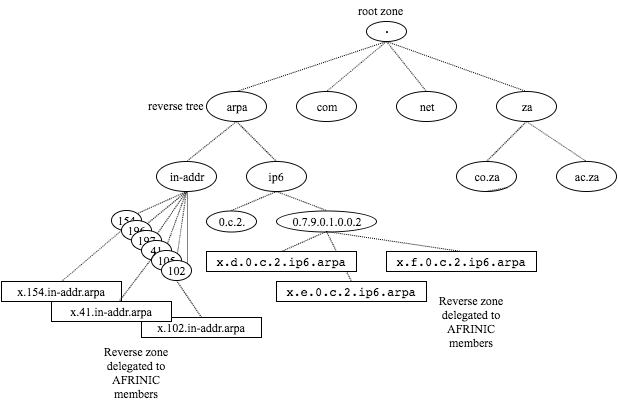
在 Knot DNS Server 中,采用了 QP Trie 作为域名的存储方案:https://github.com/CZ-NIC/knot/tree/master/src/contrib/qp-trie (早些时候的版本采用的是 HAT trie)。
IP 地址库,一般由许多条 IP 地址段(CIDR), 位置(地理区域,服务商) 的记录组成。在权威 DNS 服务器中,用作 EDNS 进行基于地理位置的解析(geoip); 在 Cache DNS 中,用于缓存各权威服务的地址段。
在 Knot 中采用的 QP trie 实现了权威服务的 geoip:(https://github.com/CZ-NIC/knot/blob/master/src/knot/modules/geoip/geoip.c)、在 Unbound 中,采用类似 CB trie 做了 EDNS 缓存(https://github.com/NLnetLabs/unbound/blob/master/edns-subnet/addrtree.c)
路由表
路由表的存储、查找算法,经过持续不断的优化,目前可以说五花八门。由于路由表的特性,基于字典树的实现是其中有代表性的一大类。目前 linux 系统可以查看到按字典树组织路由表:
$ cat /proc/net/fib_trie
Main:
  +-- 0.0.0.0/0 3 0 5
     |-- 0.0.0.0
        /0 universe UNICAST
     +-- 127.0.0.0/8 2 0 2
        +-- 127.0.0.0/31 1 0 0
           |-- 127.0.0.0
              /32 link BROADCAST
              /8 host LOCAL
           |-- 127.0.0.1
              /32 host LOCAL
        |-- 127.255.255.255
           /32 link BROADCAST
     +-- 192.168.2.0/24 2 0 1
        |-- 192.168.2.0
           /32 link BROADCAST
           /24 link UNICAST
        |-- 192.168.2.110
           /32 host LOCAL
        |-- 192.168.2.255
           /32 link BROADCAST
Local:
  +-- 0.0.0.0/0 3 0 5
     |-- 0.0.0.0
        /0 universe UNICAST
     +-- 127.0.0.0/8 2 0 2
        +-- 127.0.0.0/31 1 0 0
           |-- 127.0.0.0
              /32 link BROADCAST
              /8 host LOCAL
           |-- 127.0.0.1
              /32 host LOCAL
        |-- 127.255.255.255
           /32 link BROADCAST
     +-- 192.168.2.0/24 2 0 1
        |-- 192.168.2.0
           /32 link BROADCAST
           /24 link UNICAST
        |-- 192.168.2.110
           /32 host LOCAL
        |-- 192.168.2.255
           /32 link BROADCAST
linux IDR
使用字典树,维护整数 id 到指针的映射。
IDR 把每一个 ID 分级数据进行管理,每一级维护着 ID 的 5 位数据,这样就可以把 IDR 分为 7 级进行管理(5*7=35,维 护的数据大于 32 位),如下所示:
31 30 | 29 28 27 26 25 | 24 23 22 21 20 | 19 18 17 16 15 | 14 13 12 11 10 | 9 8 7 6 5 | 4 3 2 1 0
例如数据 ID 为0B 10 11111 10011 00111 11001 100001 00001,寻址如下
第一级寻址 ary1[0b10]得到第二级地址 ary2[]
ary3 = ary2[0b11111]
ary4 = ary3[0b10011]
ary5 = ary4[0b00111]
ary6 = ary5[0b11001]
ary7 = ary6[0b100001]
ary8 = ary7[0b00001]